Adaptive Management Predator Experiment
A replicated field experiment running across multiple states, testing whether controlling foxes and feral cats leads to measurable improvements in Malleefowl breeding activity.
Project at a glance
Project Aim
Understand the impacts that controlling predators, primarily foxes, has on Malleefowl populations. The experiment is run at sites across Australia, with paired treatment and control sites at each location to allow direct comparison.
Site Requirements
To give useful data, experiment locations must meet the following criteria:
- Have Malleefowl present in two or more locations with relatively similar environmental conditions and rainfall.
- Be separated by a distance that ensures the populations respond to management actions independently.
- Have an effective predator control strategy at the treatment site, with accurate records on intensity, frequency, and timing.
How This Works on the Ground
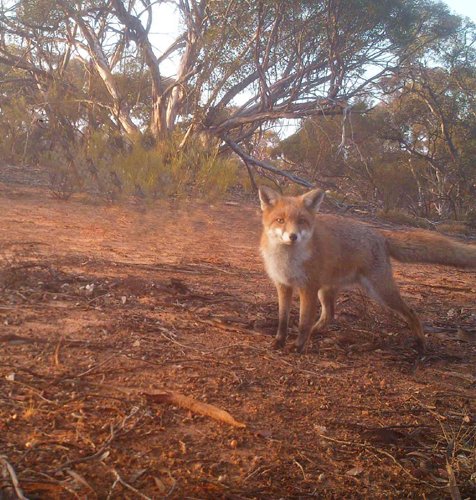
All experiment locations have mound activity sampling done and are monitored annually in accordance with the Malleefowl National Monitoring Database protocols. In addition, all sites have motion-sensor cameras deployed to detect the activity of predators, mainly foxes and cats, as well as other species such as goats, kangaroos, rabbits, deer, and pigs.
Volunteers help review photos to identify these species, contributing directly to the quality of data collected across the experiment.
How This Benefits Malleefowl
Predator control is widely applied as a conservation tool, but hard evidence of its direct benefit to Malleefowl breeding outcomes is limited. This experiment provides the rigorous, replicated evidence base needed to justify and guide predator management at scale across the species' range.
Results from this project directly inform the adaptive management framework outlined in the National Recovery Plan for Malleefowl, helping practitioners identify which control regimes and landscape contexts deliver the greatest gains.